Written by:
Louise has worked across digital publishing, content marketing, and media, producing blog articles, news features, and educational resources. Her background includes writing for financial education platforms, technology publications, and global content teams. She has experience creating content for diverse audiences across international markets, adapting tone and structure to meet regional and platform-specific requirements. At WhereiPark, she produces content focused on parking, cost-saving strategies, and location-based services across the U.S. and Canada. Have any questions about content that you’d like to ask Louise? Drop her an email at Louise@spacer.com.
 Edited by:
Zarah Mae Torrazo is a contributor and writer for WhereiPark, bringing her previous experience as Head of Content at Spacer Technologies, where she led content creation for Parkhound, Spacer.com, Spacer.com.au, and WhereiPark. With nearly a decade of experience in digital content, Zarah specializes in crafting engaging, SEO-optimized writing that bridges both B2B and B2C audiences. Her work spans a wide range of industries from real estate and finance to mobility, health, and tech, with a focus on turning complex ideas into clear, actionable insights. At WhereiPark, Zarah writes extensively about multifamily property management, urban mobility trends, and the monetization of underused assets like parking. She’s particularly passionate about the sharing economy and its power to reshape how people and businesses access space, transport, and opportunity.
New to Canada? Learn essential parking rules, tips, and guidelines for street, residential, and private parking. Avoid fines and stay informed as a new Canadian resident.

Moving to Canada means adapting to new systems, and parking rules are often one of the first challenges new residents face. Parking regulations in Canada are managed at the city level, so rules can differ depending on where you live or commute. While cities share similar principles, details such as street parking limits, residential permits, and winter restrictions vary. However, fines and enforcement are taken seriously, especially in busy urban areas, such as Toronto, Montreal, and Vancouver.
What seems simple at first can quickly become confusing due to unfamiliar signage, permit requirements, and time restrictions. However, learning the basics early can help you avoid penalties and make daily life easier.
In this guide, we cover essential information, practical tips, and clear answers to common parking questions for newcomers in Canada.
Parking rules in Canada follow similar principles nationwide, but enforcement and specific details are handled at the municipal level. This means you need to stay alert and always read parking signs when traveling between cities. However, understanding the basics will help you stay compliant no matter where you live.
Knowing where parking is allowed or prohibited is essential to avoid fines or towing, so keep these zones or areas in mind before leaving your vehicle.
Rules can differ slightly by province and city, including variations in minimum distances from hydrants or intersections. Consider the distances above as general guidelines, but local signage should always take priority.
Canadian parking signs provide clear instructions, but they can be difficult to interpret at first.
Official parking signs usually follow standardized symbols across Canada, but wording and layout may vary slightly by municipality. It’s important to read signs from top to bottom and left to right, as multiple rules may apply on a single post.
Parking violations in Canada can result in immediate fines, and repeat offenses may lead to stricter penalties.
Important note: Paying or disputing tickets is usually handled online through official municipal platforms, however, most cities only allow appeals within a specific timeframe. Make sure to address tickets quickly, whether through payment or dispute, to prevent worsening the situation.
Street parking is widely available in Canadian cities, but it often comes with specific rules, payment systems, and seasonal restrictions that newcomers should understand early on.

Most street parking in urban areas requires payment, and systems may vary depending on the city.
City-specific tips:
Payment systems are updated regularly as cities adopt more digital solutions. Before parking, confirm available payment methods in your area so you can pay using the correct option.
Residential permits are often required if you do not have sufficient parking space on your property and need to park regularly on the street near your home. Here are some key things to know if you need to apply for a permit:
Newcomers can apply in person at municipal offices or online through their city’s official website. Processing times and requirements may vary, and some cities have updated their application systems in recent years to streamline approvals. However, residential parking permits in high-demand cities such as Toronto and Vancouver may involve waitlists depending on neighborhood demand.
Overnight street parking is regulated in many Canadian cities, particularly during winter months. Common restrictions include:
Winter parking rules are strictly enforced in cities like Montreal and Ottawa, where snow removal is a priority.
Parking in private lots follows different rules than public streets, and these are usually enforced by property owners, management companies, or Private Parking Enforcement Agencies (PPEAs). Understanding these differences can help you avoid unexpected charges, disputes, or towing, especially since some private parking tickets may have limited enforceability depending on local regulations.
Remember that rules vary by location and are usually posted at entrances or throughout the lot, so read the rules whenever you park in a new facility to avoid issues.
Residential buildings often have structured parking systems with clearly assigned rules.
New residents should review building-specific parking policies upon move-in, as parking rules are set by property management and may be updated without prior notice, depending on building requirements.
Certain locations have stricter or more complex parking rules due to high demand or operational needs.
Facilities such as hospitals and universities frequently update parking systems and pricing, sometimes annually or seasonally depending on demand.
Private parking enforcement in Canada differs from city-issued tickets and can sometimes be confusing for newcomers. Remember these when dealing with PPEAs:
This area of parking regulation continues to evolve, with some provinces reviewing or updating rules related to private enforcement and consumer rights in recent years.
| Can I park on the street overnight as a new resident?
It depends on the city and street. Many areas allow overnight parking, but some have restrictions, permit requirements, or winter bans. Always check posted signs, as rules vary by municipality and season.
How do I pay for parking in Toronto/Vancouver/Montreal? Toronto: Pay via Green P app, parking meters, or pay-by-plate machines. Vancouver: Pay-by-phone apps and mobile payment zones are widely used. Montreal: Combination of parking meters, apps, and pay stations depending on the area.
Is there a free grace period for parking meters in Canada? In most cities across Canada, there is no guaranteed free grace period for parking meters. Some areas may allow a very short buffer, but this varies by municipality and is not consistently enforced. In cities like Toronto, Vancouver, and Montreal, enforcement can start immediately. It’s safer to assume payment is required as soon as you park, unless a grace period is explicitly stated on signage or indicated for that specific area.
What happens if I get a parking ticket in Canada? You are required to pay or dispute the ticket within a set timeframe. Unpaid municipal tickets may lead to additional penalties, registration holds, or collection actions depending on the city.
Are there fines for not using a parking meter? Yes. Parking without payment in a paid zone can result in a ticket, even if you are parked for a short time. Enforcement is often done through parking officers or automated systems.
How do I get a residential parking permit as a newcomer? You can apply through your city’s official website or municipal office. You will usually need proof of address, vehicle registration, and identification. Processing times vary by city.
Can I apply for more than one residential parking permit? Most cities limit permits per household or address. Some allow additional permits under specific conditions, but availability depends on local regulations.
What types of residential parking permits can I apply for?
Availability and naming conventions vary by city and are updated periodically by local governments. |
Parking in Canada can feel complex at first, especially for new residents adjusting to different city rules, signage, and enforcement systems. Most challenges come from local variations, so understanding how your specific city operates is essential to avoiding fines and unnecessary stress.
Once you become familiar with street parking rules, permits, and private lot policies, day-to-day parking becomes much easier to manage. That said, in high-demand urban areas, finding reliable long-term parking can still be difficult.
If you’re new to Canada or struggling to find consistent parking, WhereiPark makes it easy to reserve monthly parking in advance so you always have a spot when you need it.
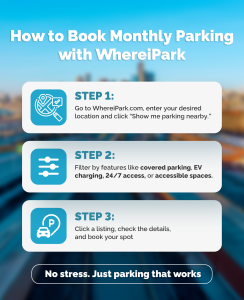
WhereiPark offers affordable traditional and non-traditional parking options across Canada and the United States. Finding your ideal spot is as easy as 1-2-3: Just browse listings in your desired location, book and pay, then park on your reserved dates.
Louise has worked across digital publishing, content marketing, and media, producing blog articles, news features, and educational resources. Her background includes writing for financial education platforms, technology publications, and global content teams. She has experience creating content for diverse audiences across international markets, adapting tone and structure to meet regional and platform-specific requirements. At WhereiPark, she produces content focused on parking, cost-saving strategies, and location-based services across the U.S. and Canada. Have any questions about content that you’d like to ask Louise? Drop her an email at Louise@spacer.com.
Louise has worked across digital publishing, content marketing, and media, producing blog articles, news features, and educational resources. Her background includes writing for financial education platforms, technology publications, and global content teams.
She has experience creating content for diverse audiences across international markets, adapting tone and structure to meet regional and platform-specific requirements.
At WhereiPark, she produces content focused on parking, cost-saving strategies, and location-based services across the U.S. and Canada.
Have any questions about content that you’d like to ask Louise? Drop her an email at Louise@spacer.com.
This will close in 0 seconds
This will close in 0 seconds